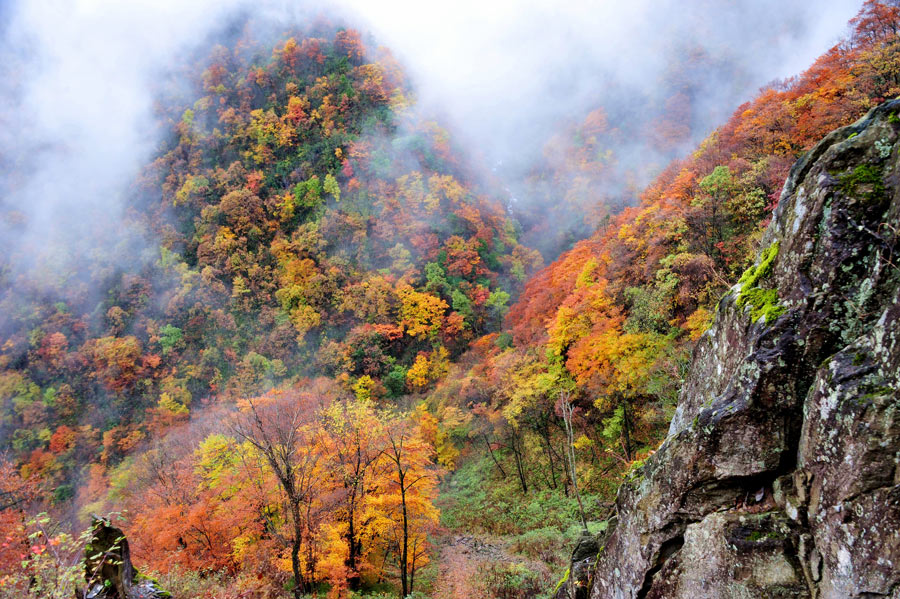
Hubei Shennongjia
Introduction
Hubei Shennongjia is a renowned natural site located at the confluence of three counties - Badong, Xingshan, and Fangxian - in Hubei province, China. This region is celebrated for its unblemished environment, diverse landscapes, and abundant wildlife. The area not only showcases majestic peaks rising over 3,000 meters above sea level but also features serene valleys, making it a significant site for both ecological and botanical research. Recognized as a World Heritage Site in 2016, Shennongjia has played a vital role in the history of botanical studies, attracting international plant collecting expeditions in the 19th and 20th centuries. In 2021, the Chongqing Wulipo National Nature Reserve officially become part of the Hubei Shennongjia World Heritage Site after a minor modification to Shennongjia's boundaries according to the 44th session of the World Heritage Committee.
Geography
Shennongjia is situated within a transitional ecotone from the plains and foothill regions of eastern China to the mountainous areas of central China. It lies along a climate transition zone where subtropical and warm temperate climates converge, influenced by the Subtropical Gyre. The reserve encompasses various vertical vegetation zones, namely subtropical, warm temperate, and cold temperate, providing a unique venue for ecological research on biodiversity and vegetation transition. Covering a total area of over 70,467 hectares, the site includes significant geographical features such as its peaks, valleys, and karst landforms, which contribute to the region's remarkable natural beauty and ecological significance.
History
The Shennongjia region has a long history of scientific interest, particularly in the field of botany. It gained prominence through notable international plant collecting expeditions conducted during the 19th and 20th centuries. From 1884 to 1889, over 500 new plant species were documented in the area. The site was officially established as a nature reserve in 1982 to protect its diverse ecosystems and significant biodiversity. Shennongjia's historical significance is further enhanced by its connection to Chinese mythology, being associated with Emperor Yan, also known as Shennong, who is said to have resided in the area.
Biodiversity
Shennongjia is considered one of China's three major centers of endemic plant species. Its geographical and climatic transitions have fostered exceptional biodiversity, making it a hotspot for species richness and endemism.
The region is home to an impressive 3,767 species of vascular plants, including 590 temperate plant genera. Among these, 205 plant species and two genera are endemic to the area, while 1,793 species are endemic to China. The rich plant diversity is further highlighted by the presence of over 150 million azaleas, with about 35 varieties, which cover a significant portion of the wilderness.
Shennongjia's fauna is equally diverse, with more than 600 vertebrate species recorded, including 92 mammals, 399 birds, 55 fish, 53 reptiles, and 37 amphibians. Additionally, over 4,300 insect species have been identified in the region. The area is a sanctuary for numerous rare and endangered species such as the golden snub-nosed monkey, clouded leopard, common leopard, Asian golden cat, dhole, Asian black bear, Indian civet, musk deer, Chinese goral, Chinese serow, golden eagle, Reeve's pheasant, and the Chinese giant salamander.
Tourism
Attractions
Tourism in Shennongjia is driven by its captivating natural beauty and biodiversity. The region offers a variety of attractions, including its towering peaks, lush valleys, vibrant forests, and unique karst landforms. Key scenic areas include the Shennong Altar, where visitors can explore the legend of Shennong, and the Guanmenshan Scenic Area, known for its diverse flora and fauna. Dajiuhu National Wetland Park offers visitors an enchanting experience with its mist-covered wetlands, while the Wild Man Cave allows exploration of the area's folklore.
Activities
Visitors to Shennongjia can engage in a wide range of activities. Hiking through forests, climbing mountains, exploring caves, and observing wildlife are popular pursuits. The area also offers opportunities for skiing during the winter months. Seasonal attractions include the Shennongjia Alpine Azalea Festival, which celebrates the blooming of azaleas and features a photo competition. The region's infrastructure is continually being developed, with plans for improved transportation access to accommodate growing tourism.
Cultural Significance
Shennongjia holds profound cultural significance in Chinese history and mythology. It is named after Shennong, a legendary figure credited with pioneering agricultural techniques and herbal medicine. The region is believed to be where Shennong conducted his experiments with herbs, contributing to his mythological status. Additionally, the area is linked to the legend of the "wild man," China's equivalent of Bigfoot, although no scientific evidence has confirmed its existence. This folklore has been passed down through generations and contributes to Shennongjia's cultural allure. In 2016, the legend of the "wild man" was added to Hubei province's intangible cultural heritage list, further cementing its cultural legacy.








